Tag: teeth whitening

Tooth Whitening Reviews

Teeth Whitening Dental Clinics in Thailand

Tooth Whitening Reviews

No post found

Have you had tooth whitening done in Thailand that you would like to share with others. Please do feel free to email us at bangkokdentalcenter@hotmail.com in sharing your feedback with other

Teeth Whitening Dentists

Teeth Whitening Dental Clinics in Thailand

Ask Your Thailand Teeth Whitening Dentist

Please do feel free to drop us a note on any questions you might like to ask with our  tooth whitening experts and dentists at our Thailand Tooth Whitening Dental Clinics.

Veneers Whitening Dentists

Dr. Vichulada Phunthikaphadr DDS., MSc.,

  • DDS., Chulalongkorn University
  • Certificate in Restorative Dentistry, University of Michigan. Ann Arbor, USA
  • Master Degree in Restorative Dentistry, University of Michigan. Ann Arbor, USA
  • Master Degree in Endodontics, Mahidol University
  • Certificate in Lumineers

Dr. Nontapan Teppanich DDS.,

  • DDS., Srinakharinwirot University
  • Graduate Diploma in Clinical Sciences Degree (Prosthodontics), Chulalongkorn University

Dr. Suthida Tunsiriroongruang DDS., MSc.,

  • DDS., Srinakharinwirot University
  • MSc., Clinical Sciences, Chiang Mai University

Dr. Sarinya Aekpitakdamrong DDS.,

  • DDS., Prince of Songkla University
  • Certificate in Aesthetic Dentistry
  • Ex-Lecturer in Operative Dentistry at Prince of Songkla University

Dr. Jutarmart Chanasriyotin DDS., MSc.,

  • DDS., Srinakharinwirot University
  • MSc., Clinical Sciences, Chiang Mai University

Dr. Kittima Siripanich DDS.,

  • DDS., Chulalongkorn University
  • Certificate in Esthetic Dentistry, University of California of Los Angeles (UCLA), USA

Dr. Natchaya Wattanakongtong

  • DDS., Chulalongkorn University
  • Graduate Diploma in Clinical Sciences Degree (Operative), Chulalongkorn University

Dr.Chatsuda Pawasoottiku

  • DDS., Chulalongkorn University
  • MSC., in Prosthodontics,Chulalongkorn University

Dr. Soontharaporn Wongsirikul DDS.,

  • DDS., Prince of Songkhla University
  • Diploma in Clinical Dentistry, The University of Adelaide, Australia

Teeth Whitening Dentists

Dr. Auraiporn Lovakit DDs.,

  • DDS.,Chulalongkorn University

Dr. Jareeporn Satthasuk

  • DDS., Chaing Mai University

Dr.Mueanjan Lertviwatkul DDS.,

  • DDS., Chulalongkorn University

Dr.Vasapran Watanasuwan DDS.,

  • DDS., Srinakharinwirot University

Dr.Chaiyapol Chaweewannakorn DDS.,

  • DDS., Mahidol University

Teeth Whitening Clinics

Teeth Whitening Dental Clinics in Thailand

Teeth Whitening Dental Clinics in Thailand

Many dental clinics in Thailand have promotional prices for tooth whitening treatment advertising lowest in town or a beats all prices marketing scheme. It is good practice to on check whether the dental clinic do actually use genuine tooth whitening treatment brands and genuine tooth whitening machines as they market corresponding to their tooth whitening treatment fees.

Certain dental clinics may have clauses such as payment only in cash for taxation avoidance or have hidden costs charged during consultation, checkup or at the final treatment fees that you may like to check prior to your tooth whitening treatment.

At BIDC teeth whitening clinics in Thailand, payment may be made in both thai baht cash or credit cards with no hidden taxation or credit card surcharges. Transparent pricings for tooth whitening treatments prices and teeth whitening promotions are assured at our dental clinics

Opening Hours


Monday to Saturday Sundays
Bangkok International Dental Center (BIDC) Ratchadapisek 9.00 to 20.00 9.00 to 17.00
BIDC at Emquartier Dental Clinic 10.00 to 20.00 10.00 to 17.00
BIDC at Siam Paragon Dental Clinic 10.00 to 20.00 10.00 to 17.00
Bangkok International Dental Hospital (BIDH) Ploenchit 9.30 to 20.00 9.30 to 17.00
Phuket Dental Signature at Patong 10.30 to 20.00 10.30 to 17.00
Chiangmai International Dental Clinic (CIDC) 9.00 to 20.00 9.00 to 17.00

Bangkok International Dental Center (BIDC)

157, 159 Ratchadapesik Rd. Din Daeng District
Bangkok 10400 Thailand

Tel: +66 (0) 2 692-4433 (BIDC)
Fax: +66 (0) 2 248 6196
Email : contact@bangkokdentalcenter.com
Website: www.bangkokdentalcenter.com

BIDC at Emquartier Dental Clinic

EmQuartier shopping center 4th floor, Building A. EmQuartier Shopping Complex
693 Sukhumvit road, Klongton-Nue, Wattana, Bangkok, Thailand 10110

Tel :0972959872
Email : eq@bangkokdentalcenter.com
Website : dentalsignature.com

BIDC at Siam Paragon Dental Clinic

Siam Paragon Mall, 2nd Floor,
Room 238 North Colonnade (opposite Asia Books)
Rama 1 Rd.,Pathumwan, Bangkok 10330 (at BTS Siam Station)

Tel : +66 (2) 610 9630 (Bookings)
Tel : +66 (2) 610 9633 (Alternate)
Email : ds@bangkokdentalcenter.com
Website : dentalsignature.com

Phuket Dental Signature at Phuket

Phuket Dental Signature at Phuket
189 Rat-U-Thit 200 Road Patong, Kathu, Phuket 83150, Thailand
Tel : +66 76-341-700
Mobile : +66 91-889-6199
Email : phuket@bangkokdentalcenter.com

bangkok dental hospital

BIDH Dental Hospital

98 Sukhumvit Soi 2, Khlong Toei,
Ploenchit area, Bangkok 10110
Entrance via both Soi Duang Phithak Rd and Sukhumvit Soi 2
Mobile : +66 95-517-1587
Email : contact@dentalhospitalthailand.com

Chiangmai International Dental Clinic

Chiangmai International Dental Clinic (CIDC)

11 Nimmanahaemin Soi 3 Nimmanahaemin Rd,
Suthep, Muang District, Chiang Mai 50200

Tel : +66 52-089-323 (Bookings)
Tel : +66 52-089-322 (Bookings)
Mobile: +66 95-517-5782
E-mail : contact@chiangmaidentist.com
Website : chiangmaidentist.com

Post Care Instructions

Bangkok Tooth Whitening in Thailand

Teeth Whitening Post Care Instructions

After teeth whitening, post care for your newly whitened teeth include:

  1. avoiding dark-colored foods and beverages as well as smoking for at least a week after whitening. Whenever possible, sipping dark-colored beverages with a straw.
  2. practicing good oral hygiene, brushing and flossing after meals and at bedtime
  3. follow-up or maintenance whitening when color shades start to fade

Tooth Whitening sensitivity

Tooth bleaching can cause a temporary increase in tooth sensitivity to temperature, pressure and touch. Some individuals experience spontaneous shooting pains or “zingers” down the middle of their teeth.

Individuals at greatest risk for whitening sensitivity are those with gum recession, significant cracks in their teeth or leakage resulting from faulty restorations.

Whitening sensitivity normally lasts no longer than a day or two, but in some cases whitening sensitivity may persist up to a month. If so, toothpaste containing potassium nitrate for sensitive teeth may be recommended for use.

If there is whitening sensitivity in teeth post tooth whitening treatment , there are several ways in reducing whitening sensitivity in teeth:
a) avoid acidic and citrus drinks and spicy foods as well as extreme hot or cold temperature foods
b) use toothpaste for sensitive teeth
c) take pain relieve medication where necessary

Teeth Whitening FAQs

Bangkok Tooth Whitening in Thailand

How do you know if you are suited for tooth whitening?
There may be certain contra-indications for tooth-whitening. You may want to start by speaking with your tooth-whitening dentist. He or she can tell you whether tooth-whitening procedures would be effective or recommended for you.

Tooth whiteners may not correct all types of tooth discoloration. In general, yellowish hued teeth will probably teeth bleach well, while brownish hued teeth may teeth bleach less well, and grayis hued teeth may not teeth bleach well at all.

Below are some factors of considerations prior to determining tooth-whitening treatment, dentist tooth-whitening or home tooth bleaching is to be done:

  1. No amount of teeth whitening will yield “unnaturally” white teeth.
  2. Teeth whitening only works on natural teeth and not on prosthetics such as crowns, bridges, veneers, fillings, inlays/onlays and bonding. Thus to avoid technicolor effect, tooth-colored restorations will likely need replacement after teeth-whitening
  3. Recessed gums often reveal their yellowish root surfaces at the gum line that is proven difficult to teeth whiten.
  4. Pregnant or nursing women are advised to avoid teeth whitening for precautionary reasons. There are however no known or researched impacts/effects of tooth whitening on fetus or baby
  5. Teeth with certain stains from trauma and tetracycline staining do not respond well to teeth whitening
  6.  Tooth and gum hypersensitivity. To avoid a hypersensitive reaction, your dentist is likely to recommend take-home tooth bleaching trays with a low concentration of carbamide peroxide that is normally not as potent as hydrogen peroxide.
  7. Deep and intractable staining. Some stains are resistant to high-concentration in-office bleaching.. In such cases, dentists may recommend a supervised regimen of intensive take-home tooth bleaching or alternatives to peroxide bleaching such as bonding, crowns or porcelain veneers.
  8. Teeth that have become transparent with age, particularly true of the front teeth, which are thin to begin with may not be suited for tooth whitening.
  9. If you are taking photoreactive medication, undergoing photochemotherapy, patients with melanoma, or are light sensitive, please do kindly consult your physician prior to the procedure as well as highlighting this to your tooth whitening dentist on any contra-indications for having in-office tooth whitening treatment done.

Is tooth whitening safe?
Extensive research and clinical studies indicate that dentist tooth whitening teeth under the supervision of a tooth whitening dentist is safe. In fact, many dentists consider whitening one of the safest cosmetic dental procedure available.

Tooth whitening is however not recommended for children under 13 years of age and pregnant or lactating women. There are also certain factors of considerations a tooth whitening dentist will look at prior to determining if in-office tooth whitening is suited for each individual case.

Tooth whitening is a well established procedure in cosmetic dentistry. Hydrogen Peroxide H2O2, the active tooth whitening agent used in tooth whitening treatmnets has been safely used for many years in the treatment of gums and other oral soft tissue.

Are there any teeth whitening risks?
Teeth-whitening treatments are considered to be safe when procedures are followed as directed. However, there are certain risks associated with bleaching that you should be aware of:

Sensitivity: Tooth bleaching can cause a temporary increase in sensitivity to temperature, pressure and touch. This may occur for in-office dentist whitening, where higher-concentration of whitening agent is used. Some individuals experience spontaneous shooting pains (“zingers”) down the middle of their front teeth.

Individuals at greatest risk for whitening sensitivity are those with gum recession, significant cracks in their teeth or leakage resulting from faulty restorations.

Whitening sensitivity lasts no longer than a day or two, but in some cases may persist up to a month. Some tooth whitening dentists recommends using toothpaste containing potassium nitrate for sensitive teeth.

Gum irritation: There is a possibility for those indidviduals using use peroxide whiteners to experience some degree of gum irritation resulting from the bleach concentration or from contact with the whitening trays. Such irritation typically lasts up to several days, dissipating after teeth bleaching has stopped or the peroxide concentration lowered.

Technicolor teeth: Restorations such as bonding, dental crowns or porcelain veneers are not affected by teeth whitening and therefore maintain their default color while the surrounding teeth are whitened. If there are a large number of prosthetics done, individuals may like to consider having the prosthetics replaced as well post tooth whitening.

How white can tooth whitening treatment go?
Teeth whitening results are subjective, varying considerably from person to person depending on the structure of the teeth. Many are immediately delighted with their outcome, while others may be disappointed. Before you embark on any tooth whitening treatment, ask your dentist for a realistic idea of the results you are likely to achieve and how long it should take to achieve them. Expectations play a major role in teeth whitening. The teeth whitening process is effective on most discolored teeth. Darker stains, such as those caused by antibiotics and grayer tones teeth, are more difficult to whiten.

How long does the tooth whitening results lasts?
Teeth will be lighter than they were before. How long the tooth whitening results last will be dependent on personal habits and oral hygiene. To keep your teeth looking their best, it is recommended that flossing, brushing twice daily and following the given post whitening care instructions.

What is the difference between tooth bleaching and tooth whitening?
According to the FDA, the term “bleaching” is permitted to be used only when the teeth can be whitened beyond their natural color. This applies to products that contain bleach or hydrogen peroxide or carbamide peroxide.

The term “whitening,” on the other hand, refers to restoring a tooth’s surface color by removing dirt and debris. So any product that cleans (such as toothpastes) are considered a teeth whitener. Of course, the term tooth whitening sounds better than tooth bleaching, and is thus more frequently used.

What is the difference between hydrogen peroxide and carbamide peroxide?
The bleach preference for in-office dentist whitening is the fast-acting and powerful hydrogen peroxide. When used in professional teeth whitening, hydrogen peroxide concentrations range from approximately nine percent to 40 percent.

The bleach of preference for at-home teeth whitening is slower acting carbamide peroxide, which breaks down into hydrogen peroxide. Carbamide peroxide has about a third of the strength of hydrogen peroxide. This means that a 15 percent solution of carbamide peroxide is the rough equivalent of a five percent solution of hydrogen peroxide.

Teeth Whitening Types

Types of Teeth Whitening Methods

Types of Teeth Whitening Methods

Many people are satisfied with the sparkle they get from brushing daily with a standard fluoride-containing toothpaste. If you decide you would like to go beyond this to make your smile look brighter, there are several ways in improving the whiteness of your smile:

In-office bleaching

At-home bleaching

Whitening toothpastes

Tooth Whitening Methods Comparison

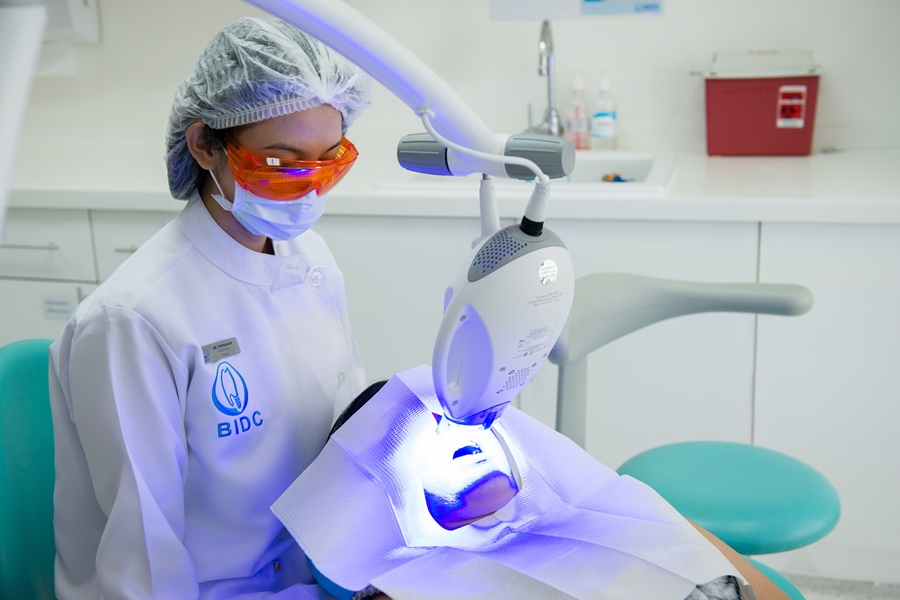
Dentist Tooth Whitening

45 minutes to 1 hour

  • immediate results
  • safe &comfortable
  • performed by dental professional

Home Bleaching Kits

7 to 14 days

  • self-applied
  • use of trays
  • no immediate results

Whitening Toothpastes

1 month plus

  • results fade if stop using toothpastes
  • used for superficial stains only


In order to whiten teeth, either a low concentration whitening agent for a long period of time (such as with home bleaching kits) is done, or a higher concentration whitening agent for a short period of time (such as with professional teeth whitening treatments) may be done.

Tooth whitening treatment only works on natural teeth. For individuals where tooth whitening is not suited, cosmetic porcelain veneers are alternative treatment option that provides a guaranteed shade of whiteness in whitening teeth.


Related Pages: